

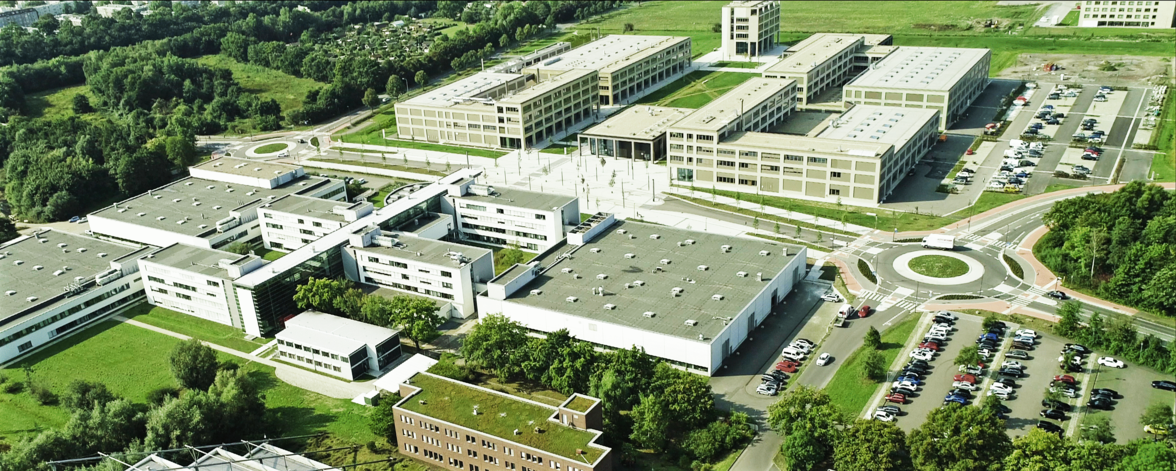
Garbsen Mechanical Engineering Campus
The Mechanical Engineering Campus covers an impressive 20,760 square metres of usable space and offers state-of-the-art facilities for research and teaching. At the centre are three institute buildings, the ultra-modern research building ‘Dynamics of Energy Conversion’ (DEW), a lecture hall building, a canteen and the seminar and communication building (IK-Haus). A technical building secures the energy supply. The buildings are arranged around an idyllic green area, creating a pleasant learning and working environment. The investment totalled around 182 million euros. The campus was financed by the state of Lower Saxony and LUH, while the DEW research building was financed by the federal government and the state of Lower Saxony.
The DEC Building
The spatial clustering of interdisciplinary working groups has not only proven to be extremely effective in achieving significant progress in line with the DEW's research program, but also promotes innovation and cooperation, as demonstrated by the acquisition of joint projects.
The core of the research building consists of both the central large-scale research facility, the “Compressor Station for the Dynamic Drive of Turbomachinery and Power Plant Test Benches,” and the test vehicles contributed by the participating institutes, which will be used in conjunction with the large-scale research facility in the future. The DEW research building and its large-scale research equipment enable transient dynamic investigations to be carried out, particularly in the important partial load range. Only with the DEW research building can the demanding test conditions required for researching partial load behavior and transient operation be created on a technical scale. The experimental infrastructure of the research building also enables research in various areas of energy and heat transition.
These projects are only made possible by the DEW research building as a central infrastructure with its unique technical and spatial conditions. The multidisciplinary composition of the working groups in the research building allows for economically viable use. Parts of the research building's infrastructure (charge air station, high-pressure special gas supply) are also used in another research building by project groups working both in the research building and beyond, thus ensuring optimal utilization.
LUH has established the transformation of the energy system as a research focus. With its research program, the DEW research building represents an important pillar of this research focus and thus strengthens the university's research profile.
The main usable area of the research building covers approximately 3,000 m², of which approximately 540 m² is office space (including meeting/work rooms) and approximately 2,000 m² is laboratory and technical space.
Test Field for Thermal Energy Conversion Systems
The newly constructed test facility for thermal energy conversion systems is used for the experimental investigation and validation of key energy conversion processes in power plants. The installed test rigs replicate the essential energy conversion components of a thermal power plant on a pilot plant scale. In contrast to conventional laboratory test rigs, they have a comparable technical and physical complexity and similar operating conditions to real components.
This high degree of realism is a fundamental prerequisite for the analysis of dynamic and transient system characteristics, the investigation of interactions between the individual subsystems, and the transfer of the knowledge gained to industrial applications. The test facility thus makes a significant contribution to technology transfer between research and practice.
The integration of the individual test rigs within a common test facility enables a cross-system view of energy conversion processes. This allows interdisciplinary methodological approaches – particularly from the fields of thermodynamics, fluid mechanics, measurement and control technology, and materials engineering – to be linked together. This includes the coordinated collection, evaluation, and interpretation of measurement data as well as the development and validation of models for describing complex process dynamics.
The test facility has a comprehensive technical infrastructure designed for flexible and versatile use. It comprises a total of 14 separate test cells for investigating different energy conversion processes, as well as a multi-stage compressor station that enables variable operating conditions and process control. The facility is supplemented by assembly areas for the construction and conversion of experimental setups, control centers for monitoring and regulating test operations, and workshops and office areas that support scientific and technical operations.
With the completion of the test field, a powerful and highly modular research infrastructure is now available that enables the experimental investigation, evaluation, and optimization of existing and novel energy conversion concepts. The test field creates a central basis for the development of future-oriented, efficient, and sustainable energy and power plant technologies.
©
Leibniz Universität Hannover
The test facility comprises a total of 14 test cells designed for the flexible integration of different test benches. The test facility enables the operation of motors and turbo machinery with outputs of up to 3 MW in four-quadrant operation, allowing both drive and generator operation to be simulated under variable load conditions.
The test cells are equipped with sound insulation up to 135 dB and are designed to be burst-proof. A laser protection system enables the safe use of optical measurement methods. In addition, each test cell is equipped with a removable ceiling structure to ensure efficient replacement of test specimens.
©
Leibniz Universität Hannover
Large Compressor Station
A compressor station for the dynamic drive of turbomachinery and power plant test rigs is used as the central large-scale research equipment. It occupies a key position within the interdisciplinary experimental investigations and forms the heart of the test facility's technical infrastructure.
The large compressor station consists of several main compressors and a comprehensive system of air conditioning, cooling, and control systems. This is supplemented by the associated valve and piping systems, which enable precise adjustment and control of the test air quality in terms of pressure, temperature, and humidity. This allows the process air to be supplied flexibly in both open and closed-loop operation.
The compressor station is designed so that experimental investigations with independent Reynolds and Mach number control can be carried out in a closed loop, even with high load gradients and across wide operating ranges. At the same time, the system ensures a high degree of control and repeatability, which is of central importance for precise and reproducible experimental investigations.
A vacuum station and a further smaller compressor station for experimental air and barrier air supply are available for charging and evacuating the loop system.
©
Leibniz Universität Hannover
Unique opportunities for testing turbomachinery with realistic and transient boundary conditions for all test cells
©
Leibniz Universität Hannover
LCS - Compressor Station for Experimental Air and Barrier Air Supply
A specially designed compressor station is required to set the pressure level in the test air circuit and to supply various subsystems and test benches, such as engines, combustion chambers, or sealing systems (sealing air). This system provides the required compressed air quality and quantity to ensure stable and reproducible operating conditions within the test benches.
The station is equipped with two multi-stage, oil-free screw compressors designed for continuous operation under variable load and pressure conditions. The oil-free compression process ensures high purity of the process air, which is particularly important for sensitive measurements and thermodynamic investigations.
The compressor station is integrated into the test field's central control and monitoring system, enabling automated operation.
Technical specifications:
Pressure: 8 bar +/-10 mbar
Temperature: < 35°C
Pressure dew point: < 3 °C
Mass flow: < 1.8 kg/s
ISO 8573-1:2010: Class 4 (oil-free)
Contact Person
30823 Garbsen